
CFA Level 3 essentials:
- 50% pass rate (Feb 2026), 50% average over 2014-2026
- Half constructed-response (essay), half multiple-choice format
- 350+ hours over 4-6 months recommended
- No time limit between Level 2 and Level 3
Critical differences from Level 2:
Essay format requires concise, bullet-point answers. Quality over quantity—examiners penalize fluff. Time per question = points allocated (1 point = 1 minute).Biggest mistake: Spending too long perfecting one essay question instead of attempting all questions. Always write something for every question.
I made a critical mistake during my Level 3 exam—three whole constructed-response questions left with just 15 minutes remaining. What I did next salvaged a pass, and it’s a lesson every Level 3 candidate should know before exam day.
CFA Level 3 is different from Levels 1 and 2. Half the exam is essay format where you type short answers and show calculations. The challenge isn’t memorizing formulas—it’s writing concise, relevant answers under time pressure while managing the qualitative nature of portfolio management questions.
Here’s my complete Level 3 guide, including what saved me when time ran out.

CFA Level 3: A quick overview, plus some Q&A
CFA Level 3 is a computer-based exam held twice a year in February and August.
Unlike Level 2 which is heavily quantitative and calculation-based, the real challenge in CFA Level 3 is lies in the more qualitative nature of the questions combined with half the paper being a constructed-response (written, non multiple choice) format.
We need to understand what CFA Level 3 is about to beat it.
Let’s go through some common questions I’ve received from candidates recently (and my answers):
What Is the CFA Level 3 format like?

- CFA Level 3 exam consists of vignettes (mini case studies or item sets) with multiple-choice questions and constructed response (essay) questions in total.
- These are split into 2 sessions, each 2 hours 12 minutes. Each paper will have either 6 item sets and 5 essay sets or 5 item sets and 6 essay sets. Both papers would have a mix of essay and item set questions from Feb 2023 onwards.
- Constructed-response questions are basically non-multiple choice questions, where you’ve to write concise answers to the questions and show your calculations, if applicable.
- All the 7 Level 3 topics are tested in the both morning and afternoon exam sessions. That said, there is a major shift in emphasis from topics on Investment Tools (e.g. corporate finance, FSA and quantitative methods) to portfolio management and wealth planning (35-40% topic weight). Less formulae to remember, but doesn’t mean it’s easier.
Although not tested as part of the exam, there is also a mandatory requirement from 2025 to complete one Practical Skills Module (PSM) prior to results announcement.
A PSM consists of a combination of videos, multiple-choice questions, guided practice, and case studies to develop candidates’ practical skills. It takes about 10-20 hours per module to complete.
How difficult is CFA Level 3 vs Level 2?
Well, we ourselves are divided on this question at 300Hours!
CFA Level 2 is difficult for the sheer amount of materials you have to learn and know how to calculate, whereas CFA Level 3’s curveball is the constructed-response format and the more qualitative nature of the questions.
However, once you’ve learnt how to answer succinctly in the Level 3’s constructed-response format, on balance, Level 2 is probably the more difficult paper.
What are CFA Level 3 pass rates like?
The latest pass rate for CFA Level 3 is 48% (Aug 2024), with an average of 50% for 2014-2024.
Since 2021, there has been a step change in historical trends of CFA pass rates for all levels, so it’s best to check out this article for the latest updates.
How much does CFA Level 3 cost?
The exam fees for CFA Level 3 are US$1,090-1,390, depending on how early you register.
There are other optional additional fees to consider too, such as physical copies of the curriculum, rescheduling fee and third party study materials.
For a complete breakdown and thorough estimate of CFA Level 3 exam costs, check out this article.
What are the latest CFA Level 3 curriculum & topic weights?
| CFA Level 3 Topic Area | Topic Weights |
|---|---|
| Core Topics (65-70% topic weight) | |
| Ethics | 10-15% |
| Asset Allocation | 15-20% |
| Derivatives | 10-15% |
| Portfolio Management / Construction | 15-20% |
| Performance Measurement | 5-10% |
| Specialized Pathways (30-35% exam weight, choose 1) | |
| Pathway A: Portfolio Management | |
| Pathway B: Private Markets | 30-35% |
| Pathway C: Private Wealth | 30-35% |
There have been huge changes in CFA Level 3 exam topics and weights with the introduction of electives called Specialized Pathways last year. This has broadened the appeal of CFA Program with the introduction of Private Markets (for those interested in Hedge Funds and Private Equity), as well as Private Wealth (for those interested in Wealth Management and Financial Planning).
For those considering using previous year’s books to study, it’s worth referring to the latest CFA curriculum changes article to check how much the curriculum has changed over the year.
How many hours to study for CFA Level 3?
Based on CFA Institute’s June 2019 Candidate Survey, the average CFA Level 3 candidate studied for 344 hours. However, based on our experience to increase chances of passing, studying for a minimum of 350 hours over 4-6 months is more common.
I would recommend having a look at the CFA Fast Track Plan as a guide (for students, working professionals and parents), then use our latest updated Free CFA Study Planner to customize your study plan to get going!
Is there a maximum time gap between CFA Level 2 and Level 3?
Unlike FRM, the CFA program doesn’t impose any time limit between levels, nor impose any time limit to complete all 3 levels, which is certainly helpful to have such flexibility.
However, candidates may lose momentum and motivation if they take a too long a break between exam levels.
Here’s my CFA Level 3 study plan & how to create yours
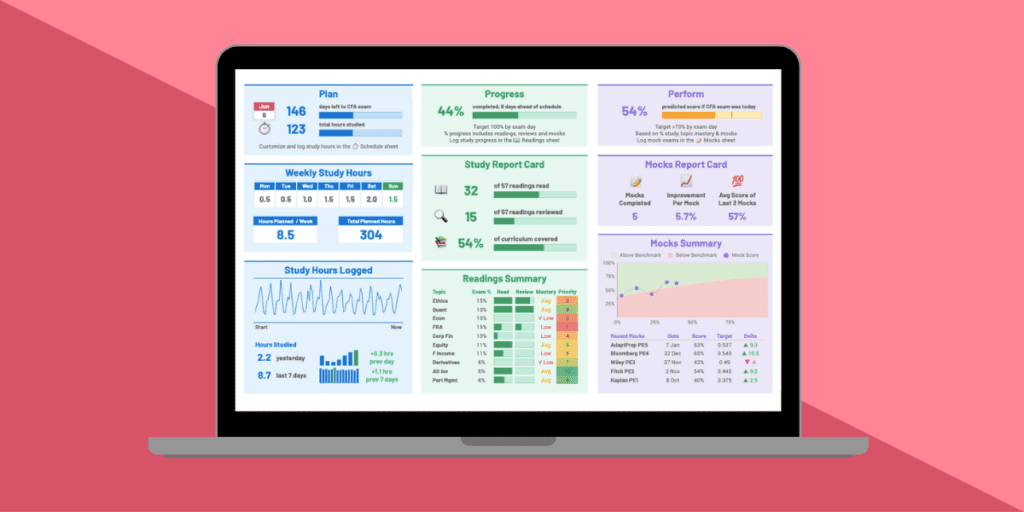
For Level 3, I didn’t use CFA curriculum as my main reference and relied on third party materials. I had a soft start to studying 6.5 months before, but only really started ramping up and properly studying with 6 months to the exams.
I just about scraped through and passed my Level 3 exam with a full time banking job in 6 months. The more qualitative nature of CFA Level 3 requires some adjustments in strategy vs Level 1 & 2.
Here are the details of my study plan, which you can easily use as a reference to tailor your study plan:
- Target at least 350 hours study time for Level 3 preparation: With 6 months (26 weeks) to prepare, that implied nearly 14 hours a week of study hours, which is more manageable than my Level 2 timeline. Similar to previous levels, my long hours during work week was exhausting, and I pretty much relied on studying full days on weekends to make up 14 hours. Of course, my case is a little extreme, if you can consistently dedicate 1-2 hours per day on weekdays, that could make things more manageable on weekends depending on your life commitments.
- Create a customized CFA study plan: For this to work and be sustainable, it is really important to tailor your plan around your work/life commitments (here’s a few CFA Fast Track study plan as reference for students / working professionals / parents). I highly recommend using the recently upgraded 300Hours’ Free CFA Study Planner, which was inspired from the first version of my study plan years ago. Not only does it track your study progress, it also identifies weaker topics, offers practice exam score benchmarks and even predicts your CFA exam score!
- Leave Ethics last: Given the recent topic weight changes, I would recommend following my suggested Level 3 study order for optimal absorption. Oh, and don’t be tempted to skip Ethics (and GIPS).
- Blitz through the reading quickly (and do Curriculum end of chapter questions): Level 3 is a different beast, where you can read all you can and your brain still feels foggy like it has learned nothing. So it wouldn’t be wise to drag on with the reading for long, instead the strategy here is to go through the readings quickly, leaving a bigger chunk of time for practice, revision and note making (next point).
- Save the last 6-8 weeks for practice exams & revision: Make sure you have covered the study material roughly once before attempting practice papers. Remember, don’t skip topics if you can help it.
- Write your own summary notes during revision for relevant sections: This doesn’t apply to all study chapters, but only the ones you find that taking notes would be useful. Not only hand writing it yourself would be a useful practice for the constructed-response morning paper, but it will save time for the revision process down the road. Refer to CFA curriculum for areas where you need more clarifications.
- Do TONS of practice papers under timed constraints: And grade them strictly (for constructed response). Then revise sections where you got wrong, then repeat. We recommend doing at least 6 practice papers, ideally under time constraint.
- Track your study and time progress: I’m not one for detailed study plans, but to ensure I don’t lose track of time, I have allocated 9 weeks out of my 26 weeks for practice and last minute revision. This means I have to cover 38 readings of Level 3 in 17 weeks, i.e. 2.5 readings per week. Use our free CFA study planner tool to help you with this.
- Take 1-2 weeks before the exam off for final preparations: This is the last Level, so it is time to make sure it is the last CFA exam you need to take. I took 1.5 weeks holiday to fully focus on nailing the rest of the practice exams and rereading materials on weaker areas. I also woke up at 630/7am daily to mimic exam conditions whilst taking timed practice exams.
CFA Level 3 tips, from my experience

Besides the 10 Commandments of CFA Level 3 (super useful by the way), here are 4 key principles that I found crucial for passing Level 3:
Time management is priority
I may sound like an old broken record, but this is worth repeating. No matter how experienced a candidate you think you are – practice is quite different from the real thing.
First thing to do when your first Level 3 paper starts is to see how much time you have per question, as number of questions vary from year to year.
As question length can vary, use the number of minutes/points to each question (this should be shown in the exam paper) to both inform you on how much time you should spend on the question, and how much information should you aim to put in your answer.
For time management purposes, consider 1 point to equal 1 minute of time to be spent on that essay question.
Try all questions to maximize your score
Second thing to do is to make sure you stick to your time limit per question, i.e. the ‘shoot-and-go’ principle.
If time is up, choose/write an answer, and move on.
This is the only way you have a chance to attempt each question, even if you’re not sure (this feeling could permeate the whole exam)!
For the first paper, it’s a little more trickier than having a multiple choice to ‘shoot’ and move on. But if you really are stuck, just write your best answer down and move on.
There is no negative marking, and my Level 3 experience showed that writing something down, such as showing your calculations or workings, helps maximize your scores even if the final answer is incorrect.
There would be (a lot of) moments in the constructed-response section where you have absolutely no clue of the answer, but some vague possibilities.
List those possible answers (limit to 2-3 only) on the side in pencil as a reminder, BUT pick the best answer for now and type them on the answer sheet. You can always revisit this if you have extra time later, but at least you have covered your bases.
Keep your constructed response answers short and simple
The common tendency when we’re not sure of an answer is to start writing a lot. Let’s include everything, maybe something will stick!
That’s not a good idea unfortunately. CFA examiners recommend writing succinct, straight to the point answers with no fluff. This means use bullet points, short sentences, shorthands for formula notation etc – these are all acceptable and in fact encouraged!
The reason is two-fold:
- You don’t get rewarded for more info than asked for. Read and answer what they are exactly asking for. Nothing more, even if you know a whole load about the topic. Seriously, the examiners have no qualms about looking at an epic essay and cheerfully crossing it all out if it’s not relevant.
- The guideline answers in your practice exams are longer and more elaborate for explanatory reasons. For the actual exams, short answers in bullet points are sufficient.
However, for questions requiring calculations, DO show your calculation methods for arriving at your answer. Even if the final answer is wrong, you may get awarded points for the right working or formula application and you’d be surprised how many points you can get with those!
Keep calm and carry on
You’re already in the exam and nearly there. No matter what happens, just chug on and finish it the best you can. You’ll be amazed how smart, resilient and resourceful you are when you face up to these challenges.
When shit hits the fan, your mental power is key. Your choice of reaction will determine the outcome.
Always be thinking: what can you do to salvage the current situation for the best outcome?
This attitude saved my ass during the constructed response part of the exam where I lost track of time and are left with 3 whole questions to do in 15 minutes – I just blasted through all the questions quickly and wrote something in all of them before time’s up.
This positive mind power is also cultivated way before the exam. I had a several funny and motivational posters, pinned on my board during the months of studying.
It made me smile and kept me going on days where I was feeling meh/argh/why-did-I-get-myself-into-this. Try it and let me know if it works for you as well?
CFA Level 3 preparation FAQs
Schweser covers about 70-75% of Level 3 content thoroughly, versus 85-90% for Levels 1 and 2. The gap is wider because Level 3 tests application and judgment, not just formulas.
What works: Use Schweser Notes for your first pass through all topics, then use the CFA Curriculum for Ethics, Behavioral Finance, and your chosen Specialized Pathway (Portfolio Management, Private Markets, or Private Wealth). These sections benefit from the curriculum’s depth and case study examples.
Always complete all CFA Curriculum End-of-Chapter questions and official mocks regardless of which study materials you use. The curriculum examples show exactly how examiners expect you to structure essay answers.
For materials comparison, see our CFA Study Materials Guide.
Type something for every single question, even if it’s just bullet points or partial calculations. There’s no negative marking, and examiners award partial credit for showing correct methodology even if your final answer is wrong.
If you have 5 minutes left and 2 essay questions untouched, spend 2.5 minutes on each. Write the key formula, show one calculation step, and bullet-point your reasoning. This could earn you 30-40% of available points versus 0% for blank answers.
During my exam, I had 3 questions left in 15 minutes. I blasted through them with bullet points only—no complete sentences. Still passed because I demonstrated understanding on every question.
Set a timer to beep every 18 minutes as a checkpoint.
Write in concise bullet points with clear labels, not paragraphs. Examiners prefer “Reason 1: [explanation]” over flowing prose. They’re grading dozens of exams and bullet points make it easier to award marks.
For calculation questions, always show your formula first, then plug in numbers, then state the final answer separately. Example format: “Required return = Risk-free rate + Beta × Market risk premium = 2% + 1.2 × 7% = 10.4%”
Use abbreviations the curriculum uses (PM for Portfolio Management, IPS for Investment Policy Statement, etc.). Don’t waste time typing full terms repeatedly.
Most importantly: Answer exactly what’s asked. If the question asks for two reasons, give exactly two—not one, not three. Extra information doesn’t earn extra points and wastes time.
It depends on your strengths. Level 2 is harder if you struggle with calculations and memorizing formulas. Level 3 is harder if you struggle with writing concise answers under time pressure or applying judgment to ambiguous scenarios.
CFA Level 2 is more quantitative (derivatives pricing, FSA ratios, fixed income calculations). Level 3 is more qualitative (portfolio construction philosophy, behavioral biases, client communication).
Time pressure is worse in Level 3 because there’s no quick guessing. In Level 2, if you’re stuck, pick C and move on (3 seconds). In Level 3, you need to type something coherent (2-3 minutes minimum per question).
Most candidates find Level 2 harder overall, but CFA Level 3 requires a complete strategy change that catches people off guard.
No—you must choose one pathway (Portfolio Management, Private Markets, or Private Wealth) and study it thoroughly. That pathway represents 30-35% of your exam, which is 27-32 questions. Skipping it means automatic failure.
Choose based on your career interests. Portfolio Management suits traditional asset managers and institutional investors. Private Markets covers hedge funds, private equity, and alternative investments. Private Wealth focuses on high-net-worth client management and financial planning.
You only study one pathway, but you must master it completely. Don’t choose based on perceived difficulty—choose based on what you’ll actually use in your career, as the motivation helps during the 350+ study hours.
For detailed pathway comparison, see CFA Level 3 Specialized Pathways Guide.
Minimum 6 full practice exams under timed conditions, ideally 8-10 if you have time. Level 3 requires more practice than Level 2 because you’re learning a new skill (essay writing) on top of learning content.
Your first 2-3 mocks will feel brutal—scoring 40-50% is normal because you’re still learning essay technique. By mock 4-5, you should be hitting 60-65%. If you’re consistently scoring under 55% after 5 mocks with 3 weeks remaining, that’s concerning.
Grade your essay answers strictly using the curriculum answer guidelines. Don’t give yourself credit for “knowing the concept” if you didn’t structure the answer correctly. Essay grading discipline separates passers from failers.
Dedicate 2-3 hours reviewing each mock—longer than taking it. For practice exam strategies, see How to Improve CFA Mock Scores.
Yes—take at least 1-2 weeks off if possible. Level 3 benefits more from study leave than Level 2 because mastering essay technique requires long uninterrupted practice sessions (4-6 hours minimum).
Optimal final two weeks:
– Week 1—complete 3-4 full mocks and review them thoroughly.
– Week 2—complete final 2 mocks, review weak topics, reread your summary notes, and simulate exam morning timing (wake at 6:30am, take mock from 9am-1pm).
If you can only take 5-7 days off, compress this to final week: Days 1-3 take two mocks, Days 4-5 review mocks and weak areas, Day 6 final mock, Day 7 exam day.
Don’t take study leave during your first 2-3 months of studying—you’ll forget everything by exam
day. Timing matters.
Take at least 6 months before retaking. CFA Level 3 content typically doesn’t change drastically year-to-year, but you need time to honestly diagnose what went wrong and rebuild your approach.
Review your score breakdown carefully. If you scored below 50th percentile in Portfolio Management, Asset Allocation, or your Specialized Pathway, those are foundational gaps that need serious work. If you failed because of time management (many blank answers), your issue is practice volume and exam technique.
Don’t rush back with the same strategy expecting different results. Common fixes needed: more practice exams (10+ instead of 4-5), stricter essay grading during practice, better time management discipline, or switching study materials if Schweser alone wasn’t working.
For retake strategy, see our CFA Fast Track Plan.
Yes—one PSM must be completed between when you take Level 3 and when results are released. If you pass Level 3 but haven’t completed the PSM, you won’t get your results until you finish it.
Each PSM takes 10-20 hours and includes videos, quizzes, case studies, and practical exercises. Topics include client communication, investment analysis application, and portfolio construction decisions.
Complete the PSM during your final 2 weeks before the exam when you’re burned out on practice exams and need a mental break. Or complete it immediately after the exam while CFA content is fresh in your mind.
Don’t wait until after results—if you pass, you want your charter as soon as possible, not delayed by PSM completion.
I hope you find my CFA experiences helpful for your preparation. Let me know if you have further questions in the comments below and feel free to share your tips too!
Meanwhile, you may find my Level 1 and 2 experiences below, along with some other useful articles:
- CFA Level 3 Topics: What is the Best Study Order?
- CFA Level 3 Tips: Top 10 Advice from Previous Candidates
- CFA Level 1: How to Prepare & Pass CFA in 18 Months
- CFA Level 2: How to Prepare & Pass CFA in 18 Months
- Fast Track CFA Charter: How to Pass the CFA Exams in the Fastest Way Possible
- Free & Upgraded – 300Hours CFA Study Planner
- Free 300 Hours Guides, including the 10 Commandment
Hi Sophie,
I got my result on 11 April and didn’t cleared my exams. Also, haven’t started preparing yet. I wanted to take your advice that shall I appear for August 2024 or appear for Feb 2025 exams? Considering, Feb 2025 format is going to change.
Hi Hardik, sorry to hear that. But hopefully you are close enough to the charter to try again. My comment will be late for this as Aug 2024 registration has closed but we did write a specialized pathway article you can refer to.
I think i will fail the level 3 exam and need to give it again please help.
i need a different strategy please help.
I am totally confused about which is the best prep provider for CFA III. PLEASE HELP!
You can check out our Reviews tab – we include ratings by CFA level so you’ll have data to decide which provider is best for you. Good luck!
Hi Sophie, I am guessing you might have come across this question before but it will be helpful if you anwser it again. I am Level III candidate and have just started preparing for the exam and I am currently confused about the approach to take . For Level I and II , I only used Schweser notes and didn’t have any problem doing well in the exam. But for LIII did you prepare solely from Schweser or did you use the CFA Institute book, especially for- Behavioural Finance, Portfolio Management-Individual & Institutional? So far, I have come across pro and con for both approaches. Would be interesting to hear what your study style was. I am personally inclined towards only using Schweser as my understanding is ( and as stated in your post above) that as long as we are precise and answer the question, we should be fine and I would imagine , Schweser does that by highlighting only the key learnings , even for the verbose topics I have highlighted above? But would be interesting to know if you would think otherwise.
Hi Pogotosh, I only knew of Schweser when I took the CFA and used their reference books exclusively for my study, as I didn’t have time to look through the CFA institute books and could only muster the energy to study on weekends. Since you’re starting early in your L3 revision, my suggestion would be to focus on Schweser in your studies to cover all your bases, as you are used to their formats for the past 2 levels. Then, with additional time when you practice your papers, you can use CFA Institute books as extra reference/practice for areas you find you’re weaker in. Hope this helps! Sophie
great am now beginning with level 1.Please can i get your email address.i need some [email protected]..Thanks
Hi Mokpokpo If you have any questions, do post it here so its shared with the community (they’re a helpful bunch!), or if its something more private, just post it at “Ask a Question” section. Sophie S